Consensus & Delphi

IAMRegen consensus programme.

IAMRegen develops consensus through two anonymous online Delphi rounds with published thresholds, ratified at the in-person Congress. The first IAMRegen consensus programme is in development — no annual consensus has yet been published.

Current status: the first IAMRegen consensus programme is in development. No annual IAMRegen consensus has yet been published. When an output is published, this page will provide the full citation, DOI, protocol, statement-level voting results, contributor and conflicts information — via IAMRegen’s official publishing partner.
The Delphi process

How the field reaches an agreed statement.

STEP 01
Protocol
Each project publishes a protocol — scope, panel, scoring scale, thresholds and conflict controls — before participation begins.
STEP 02
Round one
Participants rate statements anonymously online on a 1–9 scale and propose edits. Results are aggregated.
STEP 03
Feedback
Anonymised scores and comments return to every panellist for reflection.
STEP 04
Round two
Participants re-vote on refined statements against the published thresholds.
STEP 05
Ratify & report
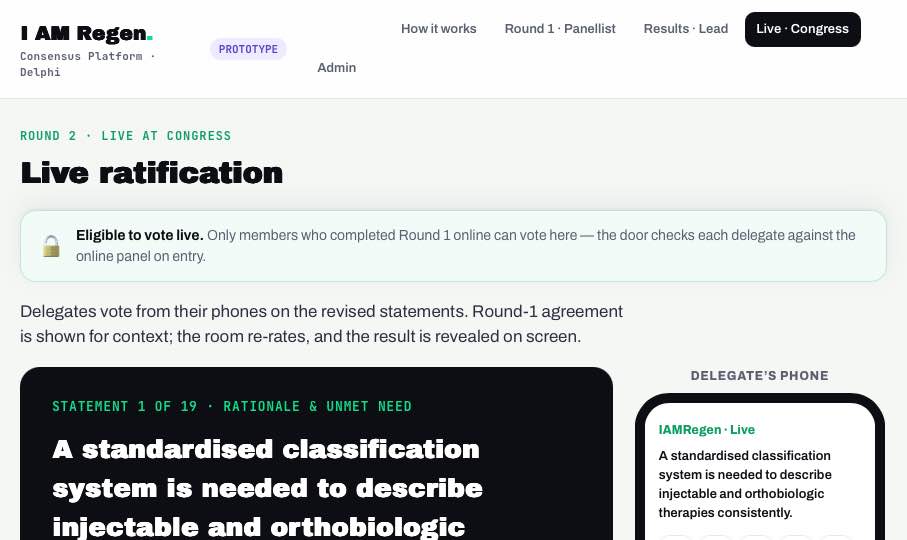
Results are ratified in person at Congress and reported with the full method. Congress cannot overturn an anonymous threshold by a show of hands.
At the in-person Congress the results are discussed and ratified. The meeting cannot overturn an anonymous threshold by a show of hands, and a material wording change requires a further anonymous vote. Remote attendance is not offered.

A consensus records agreement reached through the published method at a stated point in time. It does not replace clinical judgement, local law, regulatory requirements or patient-specific decisions. The strength of each recommendation reflects the quality and certainty of the evidence — not merely the percentage agreement.

How agreement is scored (1–9 scale)
≥80%Consensus in — at least 80% rate 7–9 and no more than 10% rate 1–3. Adopted at the published threshold.
75–79%Borderline — the statement is revised and re-rated where comments identify a remediable issue.
<75%No consensus — flagged as a research priority. The threshold cannot be lowered after results are seen.

Ratings of 1–3 count as disagree, 4–6 uncertain and 7–9 agree; “unable to rate” responses are excluded from that statement’s denominator. A project may only use a different threshold if it is justified and published before ratings are seen.

Candidate topics
Tendon repairCartilageBone healingPRP & biologicsCell therapyRehab protocolsOutcome measures
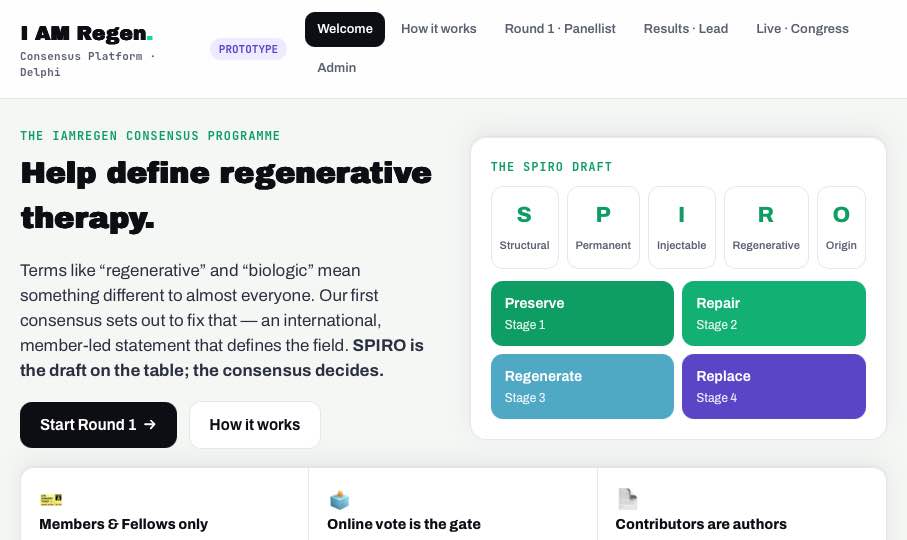
SPIRO may be described only as a proposed framework or candidate consensus topic until it has completed the protocol and the resulting output has been approved and published.
Take part in the members' area →
Recognition & authorship

From member to collaborator.

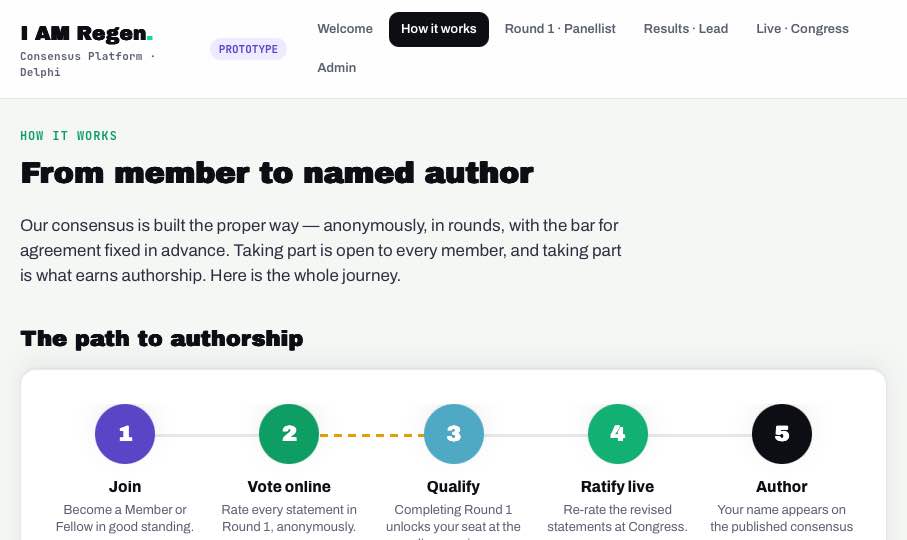
Completing both anonymous online rounds and attending the in-person Congress qualifies a participant for collaborator status for that project. Authorship is separate: authors must meet the applicable IAMRegen and journal authorship criteria — documented contribution, drafting or critical review, final approval and accountability. Membership, payment or attendance alone never guarantees authorship.
STEP 1
Join
Become a Member or Fellow in good standing — this gives eligibility to take part.
Membership
STEP 2
Both online rounds
Complete both anonymous online Delphi rounds for that project.
Required
STEP 3
Attend in person
Attend the in-person Congress ratification for that project.
In person
STEP 4
Collaborator
Both rounds plus attendance qualify you for collaborator recognition on that project.
Recognition
STEP 5
Author
Authorship is separate and contribution-based under the applicable IAMRegen and journal criteria — it is never automatic.
By criteria
🔒
Collaborator status needs both: you must complete both online Delphi rounds and attend the in-person Congress for that project. It does not, by itself, satisfy authorship criteria.
Inside the platform